Milk, the way I know it
Originally written for DEIJB Lab's #SouthAsianHeritageMonth2026. Reproduced here for the record.
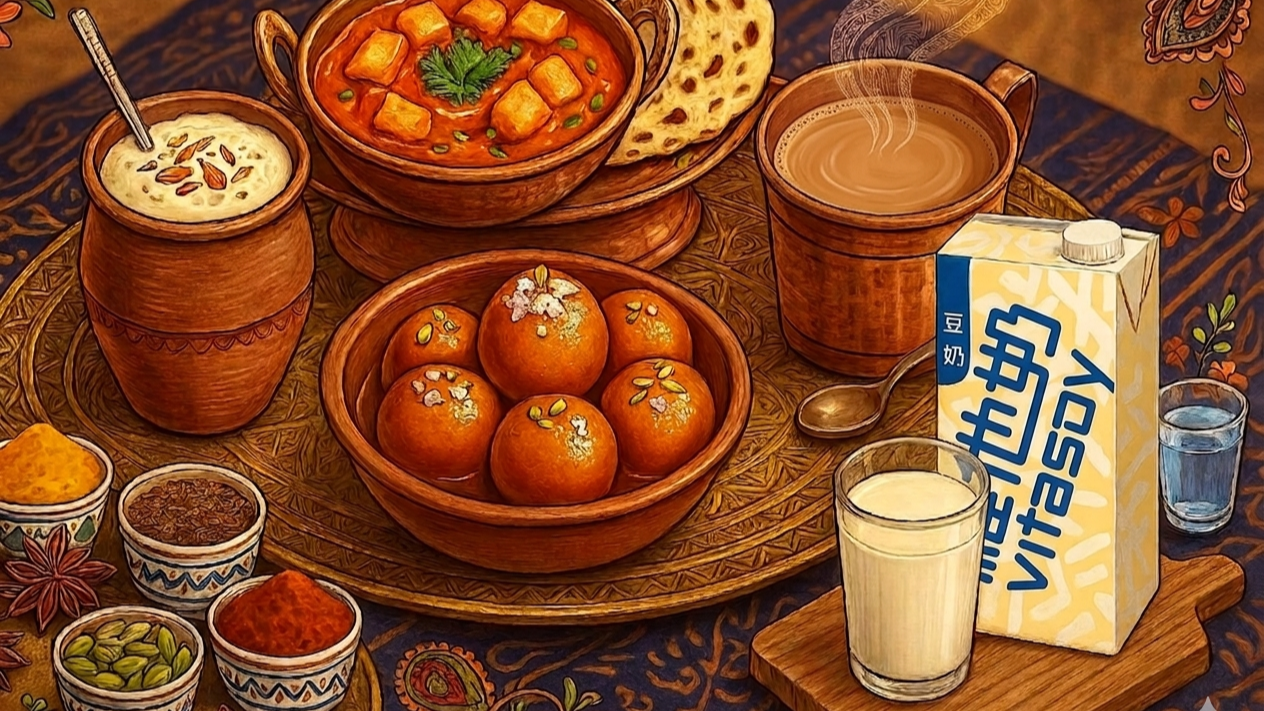
Growing up in Hong Kong as a Punjabi kid, I had a funny relationship with milk.
Outside my house, milk wasn't really milk the way my family talked about it. It was Vitasoy. I used to only like the little green carton one, I know there's a few variations you could find at every tuck shop, every 7-Eleven, every school canteen. Vitasoy was actually invented in the 1940s because most Chinese people are lactose intolerant, and the founder wanted a cheap and nutritious alternative for the growing population of Chinese immigrants. Soy milk became the milk here. A whole city built its childhood around it.
And I get why. It's genuinely good. But at home, milk meant something else entirely.
In a Desi household, milk is everywhere. It's not a drink. It's a building block. You boil it down for hours and it becomes khoya, the base for half the sweets you've ever seen at a wedding. You let it set overnight with a spoonful of starter and you get dahi, yogurt that tastes nothing like the little plastic cups at the supermarket. You churn that yogurt and you get lassi. Keep going and you get butter. Cook the butter and you get ghee. One ingredient. A whole family tree of things.
Then there's the best source of protein for vegetarians, paneer. You heat milk, add a bit of lemon juice, and the whole thing splits. You strain it, press it, and suddenly you've got the protein that holds up half of North Indian cooking. Palak paneer, shahi paneer, paneer tikka, paneer bhurji. My mom makes it fresh at home sometimes and it tastes nothing like the blocks you buy at the store. That's milk too.
Even the skin that forms on top of boiled milk has a name and a purpose. Malai. You collect it, save it, and it becomes the richness in your curry or the top of your kulfi.
Then there's the sweets. Barfi, peda, rasgulla, rasmalai, gulab jamun, kheer that simmers for an hour until the rice almost disappears into the milk (I personally prefer it cold). Almost all of them start with milk in some form.
When someone comes home, you offer them masala chai. When something good happens, somebody somewhere is heating up milk with cardamom and saffron.
I think that's the part I want to share most. Milk, for us, is how love gets served.
So when I'm in Hong Kong and I grab a Vitasoy on the way to the MTR, I'm drinking the version of this city's childhood. And when I go home, my mom hands me a glass of warm milk, sometimes with almonds, dates or haldi.